The GrandmasterThe ArtLineageArchiveThe FormsContact
Home · Lineage
傳承 · One Thousand Years

The Lineage

From an emperor on horseback to a Singaporean dojo — an unbroken thread.

Emperor Zhao Kuangyin 赵匡胤 (Song Taizu, AD 927–976), founder of Taizu quan
赵匡胤 · Emperor Taizu
太祖拳 · The Origin

The emperor on horseback

Taizu quan 太祖拳 was created by Zhao Kuangyin 赵匡胤 (AD 927–976), first emperor of the Northern Song Dynasty, who reigned from AD 960 until his sudden death in the winter of 976, when his younger brother Zhao Guangyi 赵光义 succeeded him as Emperor Taizong. A 马上皇帝, an emperor on horseback, he was known to be undefeated in battle. His art was passed down by his subjects and spread widely through Fujian during the Qing Dynasty.

Through the Yuan, Ming and Qing dynasties and into the present, Taizu quan has endured — a span of more than one thousand years.

The Masters

Four generations.

1868 – 1957
翁朝言 · Weng Chao Yan
Xiamen Master · 武举人 Wujuren

Born in 1868 during the Qing Dynasty, Weng grew up poor and was sent to work in a clansman's soy-sauce workshop in Xiamen at the age of nine. A tall, powerfully built man, he was known in his village as 大个坊 "Big Fang", and to later generations simply as 坊伯 or 朝言伯. He became a famed Taizu quan practitioner and was awarded the rank of Wujuren after an imperial martial-arts examination in 1892.

Stirred by China's defeat in the 1894–95 Sino-Japanese War, he turned away from an official career and settled in Xiamen, where in 1895 he opened his own clinic and dispensary alongside a soy-sauce business, and taught martial arts to the harbour community. He served as headman of Xiamen Port, earning the nickname 厦门港皇帝, "Emperor of Xiamen Port", and was known as a patriot and philanthropist who often gave free treatment to the poor.

An active member of Sun Yat-sen's revolutionary Tongmenghui (同盟会), he hosted Sun at a family banquet when Sun visited Xiamen in 1906. Sun later wrote inscriptions for him, among them 弘行太祖拳, "Spread the practice of Taizu quan", and 赠医送药, honouring his free medicine for the poor. His descendants long kept a plaque signed by Sun commemorating his contributions; the original was lost during the Cultural Revolution.

In 1918 he accepted a young Quek Hiong Hor 郭雄虎 as his student. Weng died peacefully at home in Dawutang village 大浯塘村 in 1957, at the age of 89.

Portrait of Weng Chao Yan 翁朝言
翁朝言 · 1868–1957
1901 – 1994
郭雄虎 · Quek Hiong Hor
The Fighter · Founder of 闽南国术馆

Quek began martial arts at nine under a Shandong master, Cao Fubiao. Moving to Xiamen in 1917, he was introduced to Weng Chao Yan and began studying Taizu quan. He travelled widely — Thailand, Malaysia, and finally Singapore. In the 1960s he was invited to a Chinese–Thai tournament, where he defeated a Muay Thai champion and returned with a purse of 20,000 baht. He founded 闽南国术馆 in Singapore to spread the art. His most notable student: Teo Choon Teck.

Portrait of Quek Hiong Hor 郭雄虎
郭雄虎 · 1901–1994
1939 – 2023 · Founder
赵春德 · Teo Choon Teck
9th Dan · Grandmaster of San Cheen Do

Sifu Teo focused on the traditional aspects of Taizu quan, which he called kuntao — old-school conditioning of the limbs, and forms practised with a combative focus. Unlike many modern schools, he taught technique inside the forms. The main form is the San Cheen 三战, namesake of the school; he established its five San Cheen forms, known to build power, stamina and the ability to withstand blows — the foundation of San Cheen Do's success in the arena and its self-defence.

Portrait of Grandmaster Teo Choon Teck 赵春德
赵春德 · 1939–2023
Present
赵术成 · Teo Sook Seng
7th Dan · Chief Instructor

According to Grandmaster Teo Choon Teck's will, San Cheen Do was passed to his son Teo Sook Seng in December 2020. Teo Sook Seng was awarded Seventh Dan in 2006 by the World Organisation of Wushu & Kungfu Masters, and carries the art forward today.

Portrait of Teo Sook Seng 赵术成
赵术成 · Present
传承书信 · Letters of Succession

In their own hand.

The succession of San Cheen Do is recorded in two handwritten letters: one from Master Quek Hiong Hor naming Teo Choon Teck his successor, and one from Grandmaster Teo Choon Teck passing the art to his son. Both are reproduced here in full.

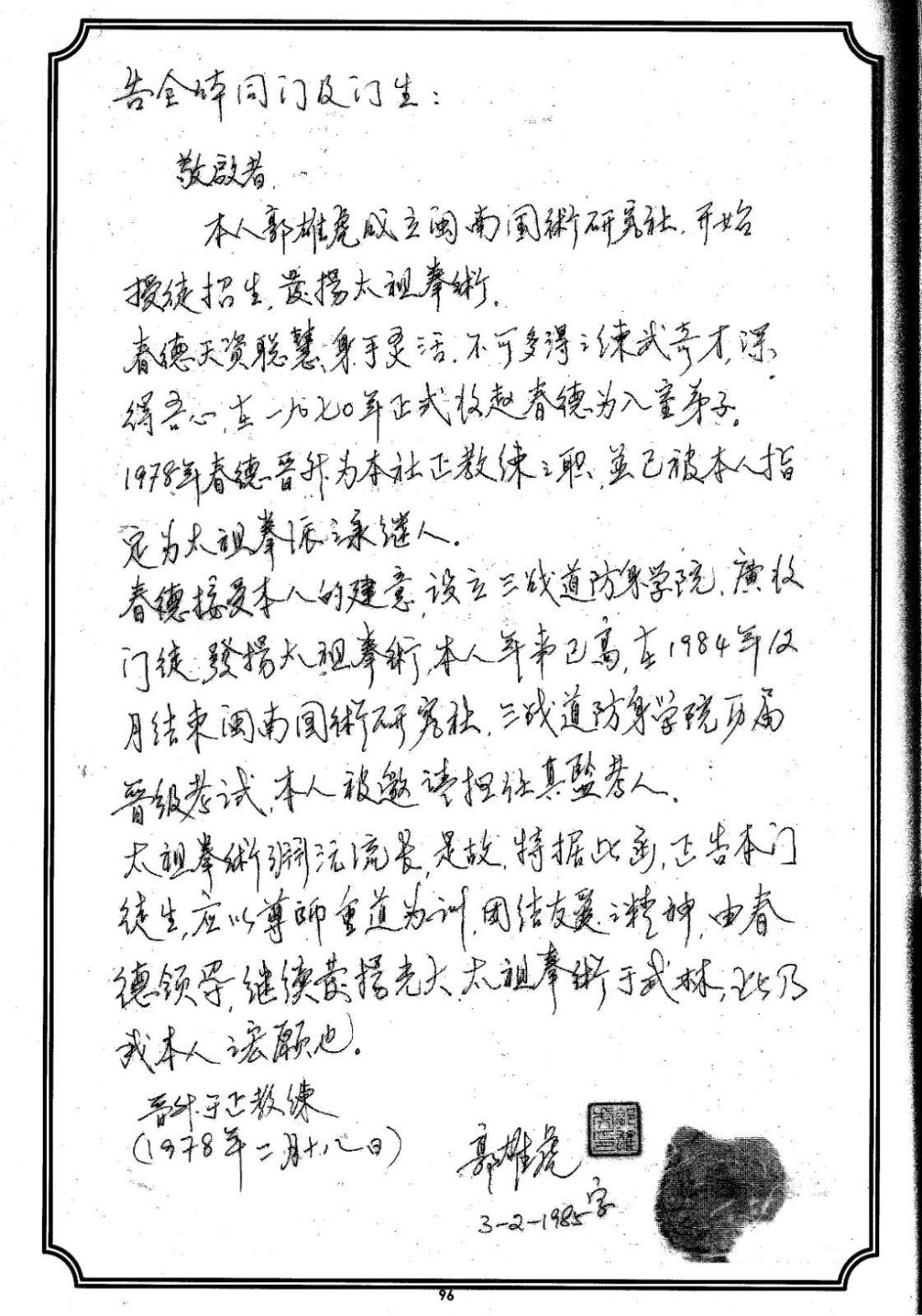
Handwritten letter by Quek Hiong Hor 郭雄虎, signed and sealed, dated 3 February 1985
3 February 1985

郭雄虎 to all disciples

Addressed to all fellow disciples and students of his school 闽南国术研究社, Master Quek records that he formally accepted Teo Choon Teck as an indoor disciple (入室弟子) in 1970, promoted him to chief instructor on 18 February 1978, and designated him successor of the school's Taizu quan.

He notes that Teo founded the San Cheen Do Self-Defence Institute at his suggestion, that he closed his own school in October 1984, and that he serves as chief examiner for San Cheen Do gradings. He asks all disciples to honour the teacher, stay united, and carry Taizu quan forward under Teo Choon Teck's leadership. Signed and sealed with his thumbprint.

View the letter →
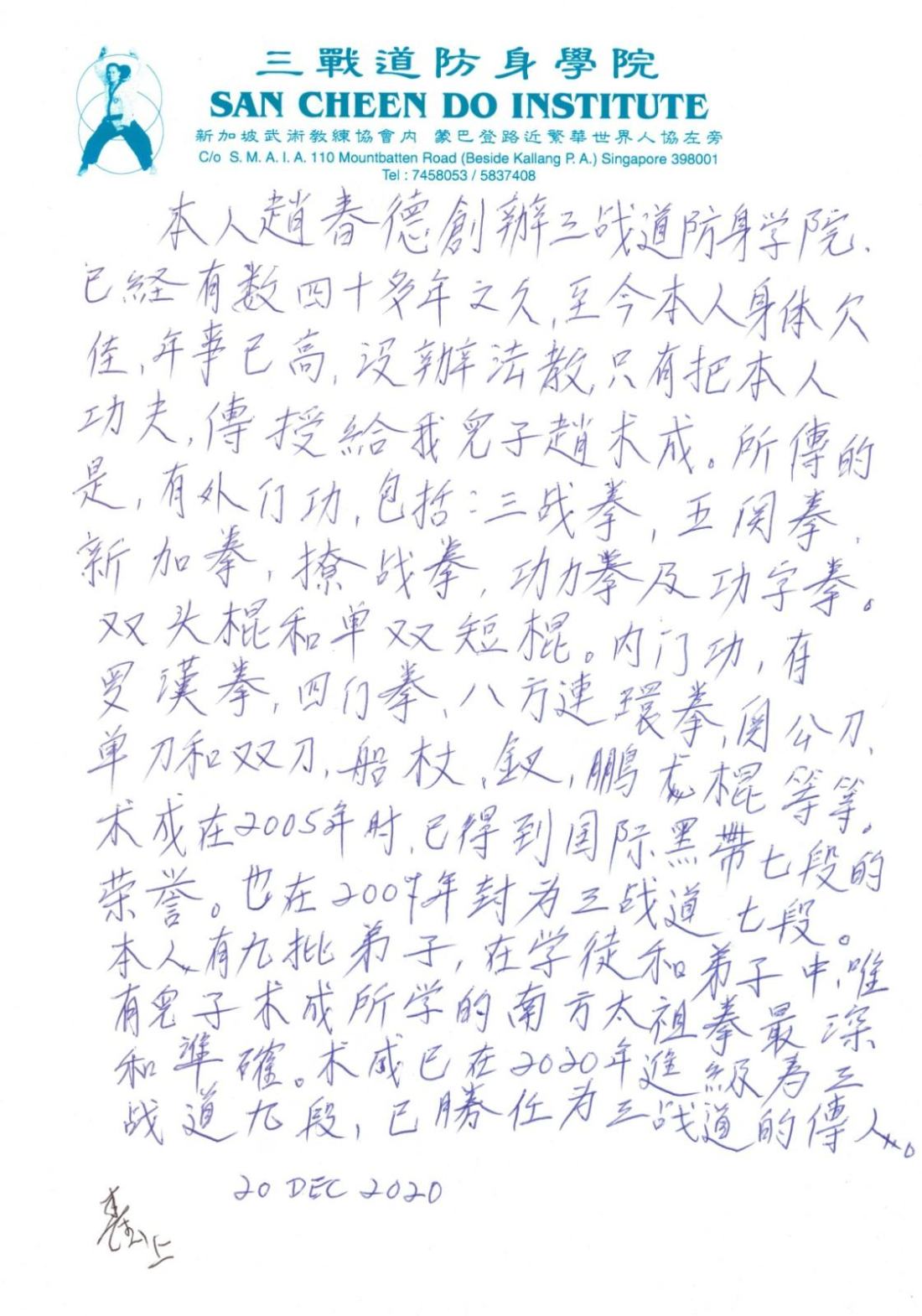
Handwritten letter by Teo Choon Teck 赵春德 on San Cheen Do Institute letterhead, dated 20 December 2020
20 December 2020

赵春德 to his son

Writing on the Institute's letterhead after more than forty years at its head, Grandmaster Teo explains that age and health no longer allow him to teach, and that he passes his kungfu to his son Teo Sook Seng 赵术成. He lists what was handed down: the external forms, including San Cheen 三战, Singa 新加 and Gong Li 功力 fists with the staff and short sticks, and the internal forms, including Luohan 罗汉, Four Gates 四门 and Eight Directions 八方连环 fists, the Guan Gong blade, single and double sabres, oar, trident and more.

Of his nine generations of disciples, he writes, only his son learned southern Taizu quan most deeply and accurately. Teo Sook Seng was promoted to San Cheen Do Ninth Dan in 2020 and named the art's successor (传人).

View the letter →

The art he preserved.